LANA's Annual Report ... and more!
/
LANA’s Annual Report!
Read MoreLyre Association of North America
The Board of LANA is recommending an increase to an additional $25 for our Supporting Membership category, which would mean an annual contribution of $65 instead of $50. We warmly invite you to consider making this increased tax-deductible contribution as a Supporting Member of the Lyre Association of North America.
Read More(Special note: These books have been marked down
to half price in our online music sales store!)
During this trip, I gave a course to adults in how to play the children's lyre. We met daily for 11 two-hour sessions over six days. Each participant, 12 ladies, had her own lyre, most of which were Chinese models. I used the newly published book "How to play the Children's Lyre by Gerhard Beilharz," but I also added my own improvisation and group games.
Read MoreNow is the time to start planning for the summer! Whether you are interested in voice, lyre, music education, or all of the above, there is something for everyone and every level. Explore these national and international retreats, conferences, symposiums and academies on our events page (click here to go to Events).
Read MoreI have been volunteering for six months in a hospice environment. A friend of mine recently loaned me a pentatonic children’s lyre which has seven strings and is quite small.
Read MoreIn the beginning of the 19th century, the folksongs of the Hebrides were collected and recorded by Marjory Kennedy Fraser and Kenneth Macleod. Piano accompaniments for the songs were composed by Marjory Kennedy.
Read MoreSlow Airs - For solo or ensemble playing on melodic and accompanying instruments, selected and arranged with chord indications and embellishments - by J. S. Clark. (Volumes 1 and 2 published in 2018 - Volume 3 now available.)
Read More...and would love to include a contribution from you for our Spring 2019 edition of Lyre Notes! We welcome news, stories, photos, and announcements of lyre happenings in your region. Our copy deadline is March 15th. We look forward to hearing from you!!
Please send your contributions to wendypolich@hotmail.com.
LANA's online music/book store, click here.
Recent blog posts and book reviews, click here.
Upcoming events in your area or worldwide, click here.
Back issues of Lyre Notes, click here.
LANA membership, or if you need to renew, click here.
Thank you and happy lyre playing!
Wendy Polich, Lyre Notes Editor
Lyre Association of North America
wendypolich@hotmail.com
www.lyreassociation.org
This book, a guide for playing the 7-string pentatonic children’s lyre, originally published in German by Mechthild Laier and Gerhard Beilharz, has been newly translated by Veronika Roemer and edited by Sheila Johns.
“This booklet is meant for parents and teachers who wish to sing and play music for or with preschool children. In this context, the 7-string pentatonic children’s lyre has proven to be an easily accessible musical instrument. In these pages, Laier and Beilharz introduce a playing technique step-by-step. Those who cannot read music will learn to do so at the same time. They give suitable examples of songs, ideas for improvisations, and discuss situations where the pentatonic children’s lyre is of particular help, i.e., at bedtime, or to accompany a story with music. In the addendum, you will find practical tips for tuning and putting on new strings as well as suggestions for further development, reference material, and contacts.”

By Elisabeth Swisher, Chicago, IL
In October 2018, I taught morning circle movement and music (lyres included) to the Module 2 students of the WECC (Waldorf Early Childhood China) training at a mountain resort near Xi’an, in the north of China. One day, in the second week, we all met in our luncheon room at the hotel, and Guoqi, our training coordinator, brought in two guests, both musicians, who came from the province of Zhuhai in the south of China, where they had just attended a music workshop with LANA president Sheila Johns, sponsored by local lyrist Vicky (Zhiying) Deng.

Sheila Johns and Vicky Deng with Angel Wing children’s lyres
Both of the student musicians live in Xi’an, and for some reason, Vicky apparently knew that I was in Xi’an and asked them to bring one of her Angel Wing children’s lyres to me as a gift from her. So the man gave me this black case and said “it is a gift….” I had no idea what was in the case, and when I opened it and found a lovely letter from Vicky along with one of her beautiful Angel Wing lyres, I was overwhelmed by such an amazing surprise and generous gift from her. In my afternoon class, I showed and played my new lyre for the students right away, and they immediately wanted to know where they might purchase one. It took me awhile to find her phone number and email address to thank her and to ask where the students could order one of her lyres.
So why did she give me this lyre right out of the blue? The year before, I was in Zhuhai, mentoring kindergarten teachers (as well as doing graduation assessments) and giving some musical advice to grade school teachers, including the importance of practicing their lyres. Vicky was there to help. One day, she asked me if I could have a look at a new lyre that she had designed and built with other people whom I had not met. When I saw this lyre, I was astonished at how beautiful it was sculpted and finished and how wonderful it sounded - better than any model I had heard before! Even the Choroi kinderharp, which I had esteemed the highest quality among all the ones I had seen and heard, did not sound as beautiful as this to my ear. I shared these impressions with Vicky, emphasizing how happy it made me to see such a high quality lyre created in China, where I had seen so many cheap but poor copies of the well-known Swedish and German kinderharps. This lyre not only looks beautiful and sounds exceptionally good, but it is also easy to tune and keeps the tuning pretty well, too.

Vicky Deng playing the Angel Wing lyre
Vicky told me that the lyre was given to me as a response to the praise I gave to this new creation, which helped her to be confident about her work and research. It made me very happy and deeply grateful for this experience: the surprise as well as the instrument itself, which was created with such love and care.
Usually on my trips to China, I do not take my own lyre with me in order to save weight and volume in my luggage, but now, I have to, because there is not yet another such Angel Wing lyre available for my teaching, and I do not wish to play any other children’s lyre anymore. I wish Vicky and the group she is working with, musical and financial success with the creation of these new and beautiful instruments.
I think that I shall never see
A poem lovely as a tree.
“Every human being has a singing voice. Our work is to unveil, take away the
hindrances and free the voice.- Valborg Werbeck-Svardstrom”
After four consecutive years of enthusiastic teaching and joyful singing, Christiaan Boele returns to bring “The School of Uncovering the Voice” back to our community for a three-day workshop. Out of the artistic impulse developed by Mrs. Valborg Werbeck-Svärdström under the guidance of Rudolf Steiner, Christiaan offers a refreshing, motivating and inspiring approach for the novice and professional alike. All are welcome who long to sing, even those who feel they cannot! No special talent required.
Two sessions each day: Session One: 9:35-10:45am; Session Two: 11:15am-12:25pm; $125 in advance, $150 at the door. For information contact Eurythmy Spring Valley: 845-352-5020, x113, info@eurythmy.org.
For anyone interested in singing in a holistic, spirit-filled and heart-opening way! Discover the innate potential of your voice. Welcome singers of all levels, musicians, teachers, and any person yearning to sing with creative renewal. No special talent or musical ability required.
Friday 6:30pm-8:30pm; Saturday 9:00am-6:30pm; Sunday 9:00am-12:30pm; Tuition $225. For more information or to register contact Shannon Boyce at 646-932-6062 or shannonaliciaboyce@gmail.com.
Christiaan Boele trained at conservatories in the Netherlands and Germany and is the leading authority in the Werbeck method. He has devoted his life to The School of Uncovering the Voice, performing, conducting and teaching courses around the globe.
We will work with metal instruments (gongs, rods, cymbals, and others), stringed instruments (lyres, including pentatonic and Bordun lyres, psalteries, chrottas), wind instruments (C-flutes, pentatonic flutes, ocarinas), and percussion instruments (drums, rattles, etc.). Our work will be based on the books by Reinhild Brass (Hörwege entdeckenI) and Gerhard Beilharz (Musik in Pädagogik und Therapie), focusing on new methods in music pedagogy and therapy, as is possible with these new instruments. No previous musical experience necessary.
This conference will be led by Veronika Roemer, professional violist, pianist, and Seminar Music Teacher at The Camphill School, Glenmoore, PA. Veronika also teaches musical renewal in China, Hungary, and North America.
Lyre Association of North America: lyrists@gmail.com / 610-608-9281
Dear friends of Sound Instruments,

Since August we live and work in Campinas / Brazil! Our blacksmith's workshop has been set up since September and some instruments have already been made for Brazil, Germany, and other countries. We have also developed a new instrument: a diatonic “Glockenspiel” (metallophone) C5–C6 and pentatonic D5–E6. The diatonic can be seen and heard in this video with a happy Christmas carol. Anyone interested in our instruments can contact us via e-mail (metal.georg@gmail.com) or telephone / WhatsApp (+55-19-997969503) or visit the website www.metalgeorg.com for details.
We wish you all a peaceful and blessed Christmas,
Daniela and Georg Ehrenwinkler
Metal Georg / AurumSom
Daniela Ozi-Ehrenwinkler, Cantoterapia-Musicoterapia-Terapiatonal
www.metalgeorg.com / 0055 19 99796950
Telemann en tijdgenoten (“Telemann and contemporaries”), music for solo lyre; arranged by Petra Rosenberg
This is a lovely collection of Baroque music by French, German, and Italian composers, many of them probably new discoveries for most lyre players. Some of the pieces are edited in two separate keys for both soprano and alto lyre. Although the arrangements are made for a solo player, many of the pieces can be played by two players (stems up and down). The difficulty level is rather high when played solo. However, this should not be seen as a deterrent, as the wide variety of pieces offers wonderful opportunities for expanding and refining one's technical skills, such as finger dexterity, damping, playing separate voices at the same time, and interpretation. Petra Rosenberg isn't giving any dynamics, tempo indications, articulation or fingerings - a wide field for discoveries for each player!
Reviewed by Veronika Roemer

From the Book - Telemann en tijdgenoten, Muziek voor lier solo
By Nancy Carpenter, Detroit, Michigan
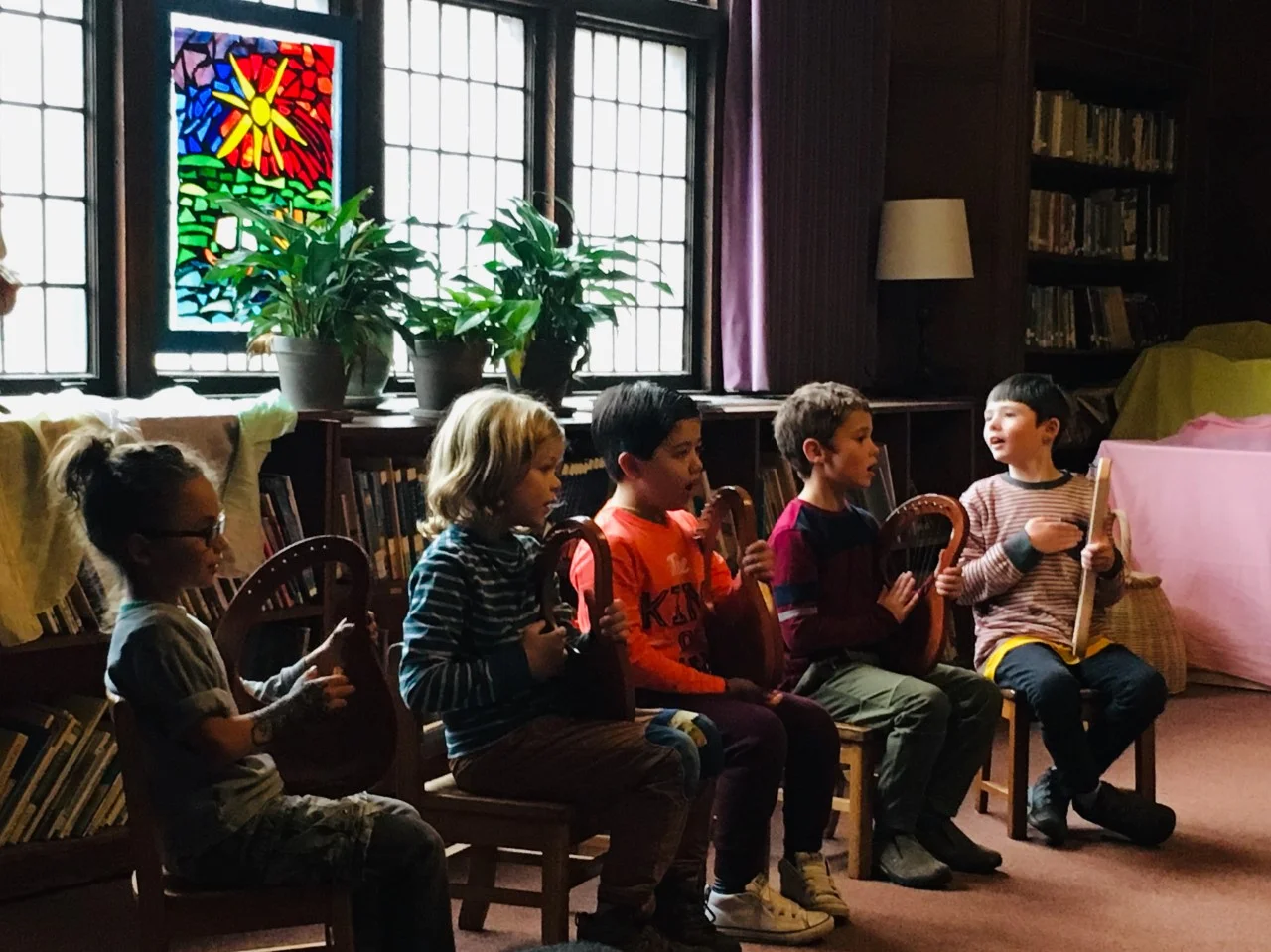
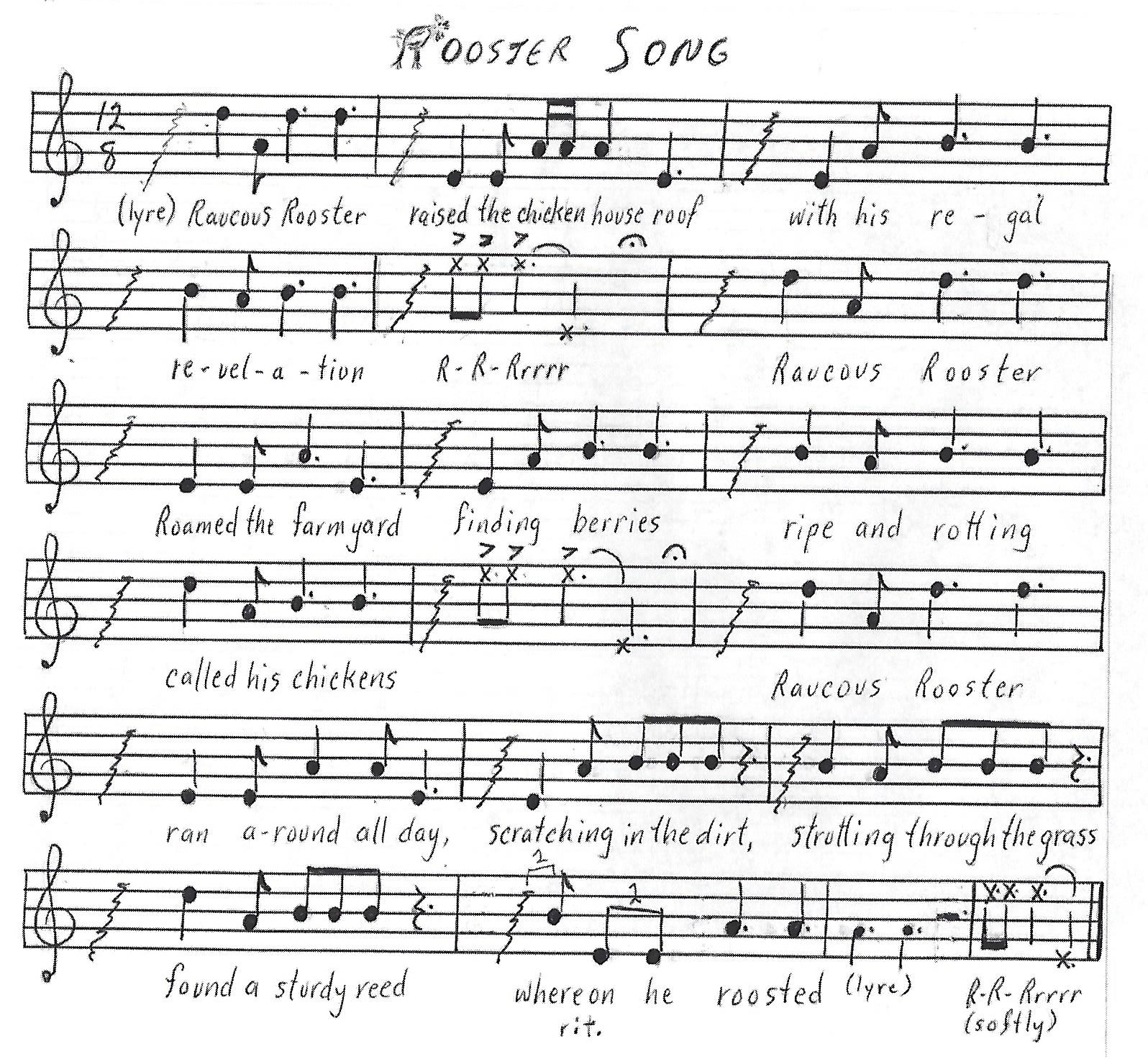
The Detroit Waldorf School had its first Winter Faire in about 10 years on December 1st. Parents of one of my students were so taken with one of our Kinderharp songs that they made a Rooster Marionette and suggested that we present it at the Faire. This is a song taken from Mary Lynn Channer’s alphabet song book, Xavier Sings of his Alphabet Friends, for the letter R called "Raucous Rooster!" It's a particular favorite of all of the children; even the older students remember it from 1st grade. These 2nd graders were so happy to share this song with a very enthusiastic audience

By Saeko Cohn, Brooklyn, New York
December 1, 2018 will always be an unforgettable day in my life with the lyre. On that day, I accompanied two kindergarten classes with my lyre at the Advent Spiral held at the Rudolf Steiner School in New York City. It was the first time I played the instrument in public. Together with four teachers singing, in the darkness, we welcomed over 20 students in each class, playing "Over Stars," "Dona Nobis Pacem," "Marjatta," "November," "There Comes a Galley Laden," and the Hebrew song "Hava Nashira" over and over. The classroom was packed with students and their families, and we played for an hour until the last student had placed his candle and exited the spiral. We then welcomed the second group and played for another hour. Including rehearsal time, I played the lyre as a soloist for over three hours that day, in front of nearly 150 people.
Reflecting on that occasion, I am reminded of the historical facts of the near coincidental birth of the modern lyre (1926), the Advent Garden (1926) and the Rudolf Steiner School in Manhattan (1928) as the first Waldorf school in North America; of the particular impulse on the part of those visionaries who created the therapeutic musical instrument, the seasonal ritual and the school. If music is a "revelation of the cosmic world" as the anthroposophic music historian Anny Von Lange has written, the Advent Garden allowed me to have a first-hand experience of the revelatory nature of music, complemented by a sensory appreciation of the solemn beauty of candle light, the children's movements, the teachers' singing, the warmth of the room and the fresh spruce scent, while sharing all the above in time and space with the community.
A few days after the Advent Garden, I feel a new strength in the center of my body; and that the candle light placed in the spiral by those 40 kindergarten children and their teachers is now internalized in me. Never have I felt such joy and strength at this time of the year. I would like to thank Ms. Myra Friedman of the Rudolf Steiner School for kindly inviting me to play for the occasion; also my lyre teachers, Kerry Lee and Channa Seidenberg for helping me to prepare for this event. In an early stage of the preparation, Kerry provided me with an authentic edition of Pracht's "Over Stars," and also with some wonderful literature about the history of the Advent Garden; toward the end of my preparation, Channa sang along and encouraged me while I played the lyre.
Strangely, however, the most memorable moment came on Sunday morning, the day after the Advent Garden, when my four-year-old son Leon hummed "Over Stars" from the beginning to the end, while he was playing with his toy trains. I was all ears, nearly petrified, pretending not to notice anything. My heart was trembling. How had he learned the song? I hardly ever played the melody of the song, because I was only concerned with learning the arpeggio accompaniment. I must have been singing unconsciously, while practicing "Over Stars" every day of the previous six weeks. Leon was too young to participate in the Advent Garden at school this year. I hope to accompany him next year!
On December 2, I also played the lyre at an Advent Garden at the New York branch of the Anthroposophical Society in America. This was a cozy gathering of thirteen adults, and we closed the evening with my playing the introduction to Leonard Bernstein's "A Simple Song." Performing at these two Advent Gardens made me realize that the sound of the modern lyre is inherently relational and therapeutic, and unlike other solo instruments, it thrives when it is played for people in a communal setting. I am grateful for having had these first opportunities to share the joy of lyre playing with others, and look forward to further musical interactions in the future.
By Diane Ingraham Barnes, Hillsdale, NY
At Hawthorne Valley School the alto lyre and 3 children’s lyres sounded in the Thanksgiving Assembly as the 3rd grade performed Arnold Logan’s “Johnny Hears the Call”. This is a delightful little musical about Johnny Appleseed, and this year it was accompanied by Diane Barnes on the alto lyre. Three of the students then played the children’s lyres on the Wagon Wheel song. The performance was much appreciated.
Also in the Berkshire-Taconic region the lyre continues to sound frequently at the Christian Community and at the many Advent Gardens being held at this time of the year. Diane Barnes will be playing the lyre for the Madonna Series further south, at the Housatonic Valley Waldorf School in Ct., on December 11. This is such a wonderful time of the year for the lyre. May it sound around the country.
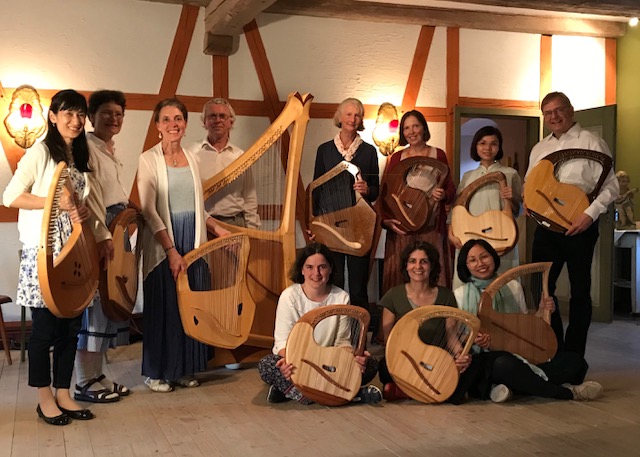
Participants of the First International Summer Lyre Academy with master lyre teachers, Martin Tobiassen and Christian Giersch
By Sheila Johns, Quito, Ecuador
Vicky Deng and Tomoko Mino at Schloss Seehaus Castle
It was mid-May of this year, and I had just finished teaching a lyre course with Japanese lyrist Tomoko Mino in the province of Zhuhai in the south of China. We were enjoying dinner with our host Vicky Deng, when the two of them suddenly asked me if I planned to go to Germany to attend the first International Summer Lyre Academy in July. I had been so busy traveling, teaching, and performing both in and out of my adopted home country of Ecuador, that I wasn’t quite sure what they were talking about. They excitedly explained that two of our most accomplished international master lyre teachers, Martin Tobiassen and Christian Giersch. were teaming up to offer this academy to experienced lyrists who wished to deepen their playing skills and enjoy some more advanced ensemble work. They informed me that they had both registered and planned to go – Vicky from China, and Tomoko from Japan, and they begged me to consider joining them! I had a deep regard for Martin and for Christian, both as musicians and as human beings, and I immediately began to imagine what a fantastic opportunity this would be.
As soon as I returned home, I wrote to Martin, who had been our master teacher guest for the LANA Summer Lyre Conference in 2016 at the Michael Fields Institute in East Troy, Wisconsin. I was warmly welcomed to join those who had already registered, and I immediately began searching for the best flights between Quito, Ecuador and Frankfurt, Germany.
In the end, the participants in this first ever Summer Lyre Academy created a remarkably international group of nine students, two teachers, and a wonderful cook. In addition to Tomoko, Vicky, another Chinese lyrist, and myself, we had participants from Holland, England, Germany, and Brazil.
We spent a truly magical week together. The setting for our work was the fairy tale Schloss Seehaus, a Baroque style castle built in the 16th century, with current construction dating to about 1780 and located in the Schwarzenberg region of Bavaria. The Lord of Seehaus is an accomplished singer with a great love for music making of all kinds, and during the summer months, he makes these stunning period buildings and grounds available for ensembles, choruses, orchestras and summer music workshops as well as sponsoring a concert series in the exquisitely appointed chapel wing of the castle. Each room is a work of art – most filled with period instruments, and I counted over 20 keyboards of some kind or other throughout the various wings and rooms of the Castle.
We each had our own unique lodging within the castle, and we enjoyed 3 beautiful homemade meals together each day in the original castle kitchen, prepared for us by a colleague of Martin and Christian who himself is a lyrist.
Prior to our arrival, we had each been asked to prepare a solo piece of music as well as to submit suggestions for ensemble music we would like to play with others. In addition, Martin and Christian had each chosen and sent us plenum pieces which we were meant to work on together.
Each participant could sign up for 4 private lessons during the week. Most of us chose to have 2 lessons each with our two master teachers. In addition, we spent the first evening pouring over all of the ensemble music and forming ourselves into small groups according to who wished to play what.
After a delicious hot breakfast, we began each day with a morning plenum where we worked together on a lively 12-tone Kanon of Christian’s as well as a stunning 3-part piece of Martin’s called Morning Bows. The approaches and musical styles of Martin and Christian were utterly and delightfully different from one another, which created a rich and complimentary experience for all of the participants!
The rest of our days consisted of private lessons, practicing on our own, and rehearsing with our various ensembles, punctuated by fabulous meals, usually outside in the beautiful gardens overlooking the gorgeous castle grounds and surrounding countryside. We spent our evenings playing for each other, which was a lovely experience – each one choosing to improvise or share something prepared in a completely accepting atmosphere of deep listening and appreciation for all efforts made, however modest. Halfway through our week, Martin and Christian presented a full public concert in the royal chapel as part of the Schloss Seehaus Summer Concert Series, accompanied by wine-tasting from the castle private label winery. On the last evening of our Academy, the 9 of us joined our teachers and presented a public concert together reflecting the variety of solos and ensembles on which we had worked during the week.
If all this sounds like a dream for any lyrist interested in improving their lyre technique, improvisation, musicianship, listening, and ensemble skills, I can assure you that IT WAS!! To add the charm and beauty of our unique setting as well as the rare opportunity to share such an intimate social experience with fellow lyrists and such incredibly accomplished teachers created a very special and truly unforgettable experience that continues to inspire me all these many months later. Even though we did not share a common spoken language, the air around us filled with a beautiful cacophony of German, English, Chinese, Portuguese, and Spanish, we quickly discovered that our universal language of music made it possible to make a genuine connection with each person as we joined our lyre sounding and singing voices in creating a tapestry of musical harmony together. Thank you, Martin and Christian, for creating an inspiring new opportunity to affirm our humanity through using the medium of the lyre to deepen our social and musical potential for the future!